
School Phone Bans Are Spreading. But What Happens When Kids Get Home?
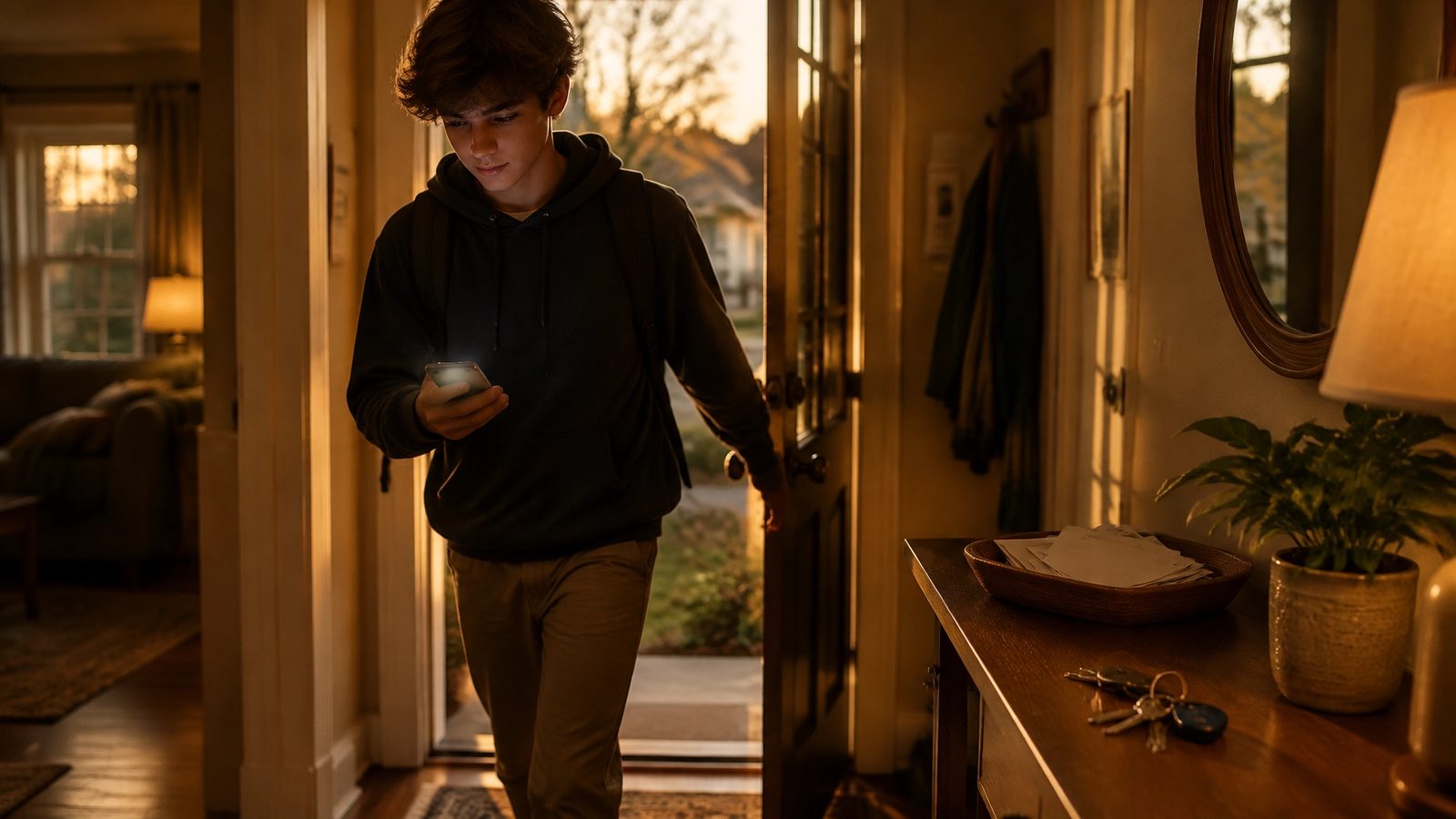
Taking phones away at school may reduce distractions. Teaching kids to manage them at home is a different challenge.
Across the country, schools are setting new limits on student phone use. That can make the school day quieter and help protect classroom time. But when the final bell rings, your teen still has homework to do, and a phone within reach.
That’s where the bigger question starts: How can you help your teen manage distractions at home, not just avoid them at school?
1. Why schools are limiting phones
Schools are responding to a familiar problem. A phone can pull attention from a lesson, interrupt a conversation, or make it harder to settle into work. State approaches vary: some limit phones during class, while others restrict use for most or all of the school day. The National Conference of State Legislatures tracks legislation in this fast-changing area, but the rules aren’t the same everywhere.1
The goal is usually straightforward: give students more room to focus, learn, and connect with the people around them. Research gives reason to take distraction seriously, but it doesn’t show that every ban produces the same results. A review of school-phone-ban studies found some benefits, while noting that the available evidence is still limited.2
A school rule can set a boundary for school hours. It can’t decide what happens at your kitchen table that evening.
The Association for Middle Level Education (AMLE) put a sharper point on this in its position paper on cell phones in middle schools. The paper’s focus isn’t simply keeping phones away from students ages 10 to 15. It’s equipping them with executive-function skills — self-regulation, time management, thoughtful decision-making — so they can “use these devices as tools, instead of being used by the devices themselves.”3
That line captures the whole challenge. A school can restrict access to a phone. But restricting access isn’t the same as teaching a child to manage their relationship with that phone. Restrictions serve a purpose. The question is what happens when they’re lifted, and the child must make decisions independently.
2. What changes when your teen gets home
For many families, the phone is still part of everyday life after school. Your teen may use it to check a homework assignment, message a friend, listen to music, or take a quick break. And a quick check can turn into a longer scroll.
A school ban may reduce phone use during the school day, but it doesn’t automatically create a homework routine. In a study of secondary school students in England, restrictive school policies were associated with less phone use at school, but not with lower overall phone use or better measured wellbeing.4 That study doesn’t tell us what will happen in every home. It does underline a useful point: school and home are different settings.
Rather than assuming a school policy will solve evening distractions, you can make a home plan that fits your teen and your family. The goal doesn’t have to be a perfect, phone-free night. It can be a more predictable start to homework, and fewer reminders from you.
AMLE’s paper also points schools toward giving students chances to practice: involving students and families in shaping policy, teaching digital citizenship, and even student-led “phone-free challenges” where kids choose to test their own limits.3 Those are recommendations to try, not proven outcomes. But the underlying idea is one parents can borrow directly. A rule can create a boundary. Practice can help a child learn what to do with that boundary — and eventually, how to make one for themselves.
3. A ban sets a boundary. Practice is what builds the skill.
When a phone is unavailable at school, a student doesn’t get to practice managing it during class. That may be the right boundary for a particular school. But at home, your teen still has to decide what to do when a notification pops up or a study task gets uncomfortable.
Here’s the key distinction: enforcing a boundary and developing a skill are two different objectives. A restriction can remove the phone from the equation. It can’t teach your teen what to do when the equation includes one.
So what does practice look like? Not another homework schedule. Not a new system of rewards and consequences. The real opportunity is stranger and more interesting than that: your teen practicing the act of managing the very device that’s competing for their attention.
Imagine your teen making a different choice. Instead of putting the phone away — or waiting for you to take it — they put it to work.
They choose to start a focus session. They position the phone where it can see them working. And they let the device that usually pulls their attention away help them stay on task.
The phone hasn’t changed. Their relationship with it has.
That’s the shift worth aiming for. Not a teenager who starts homework because they were reminded. A teenager who decides, on their own, to use their own phone as a tool for staying with the task they chose.
4. A coach, not a guard
This is the idea behind Unbusted.
A blocker app can feel like a prison guard: it enforces the boundary by taking control away from the user. Parental controls and school restrictions have legitimate uses — sometimes a clear boundary is exactly what a family or classroom needs.
Unbusted works more like a self-help coach. The phone stays with your teen, but during a focus session it takes on a new job. Your teen chooses a session length and starts the timer. The app can send a gentle reminder if your teen steps away from the camera’s view or leaves the app during a session.
Picture what that evening looks like. Instead of another round of negotiating over phone use, your teen chooses to use that phone to support their own focus. They start the session. The app provides gentle reminders and a record of how the session went. And you can step back from constant monitoring while still being able to review the session afterward.
That does not mean the phone is watching everything your teen does. Camera detection looks for your teen’s face during an active focus session. No video is recorded, stored, or streamed to parents. Session details stay on your teen’s phone. You can enter a secure parent PIN there to review a log of focus time, pauses, reminders, and time away from the app. The app doesn’t read personal texts or browsing activity.
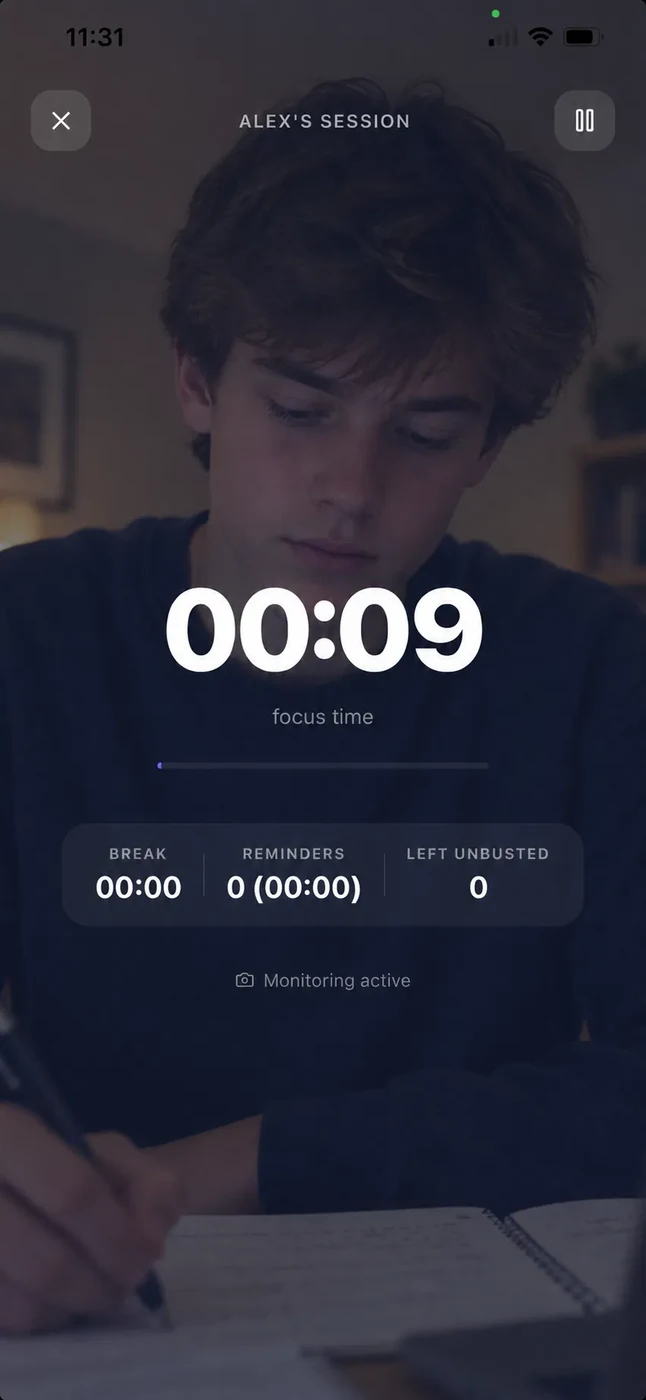
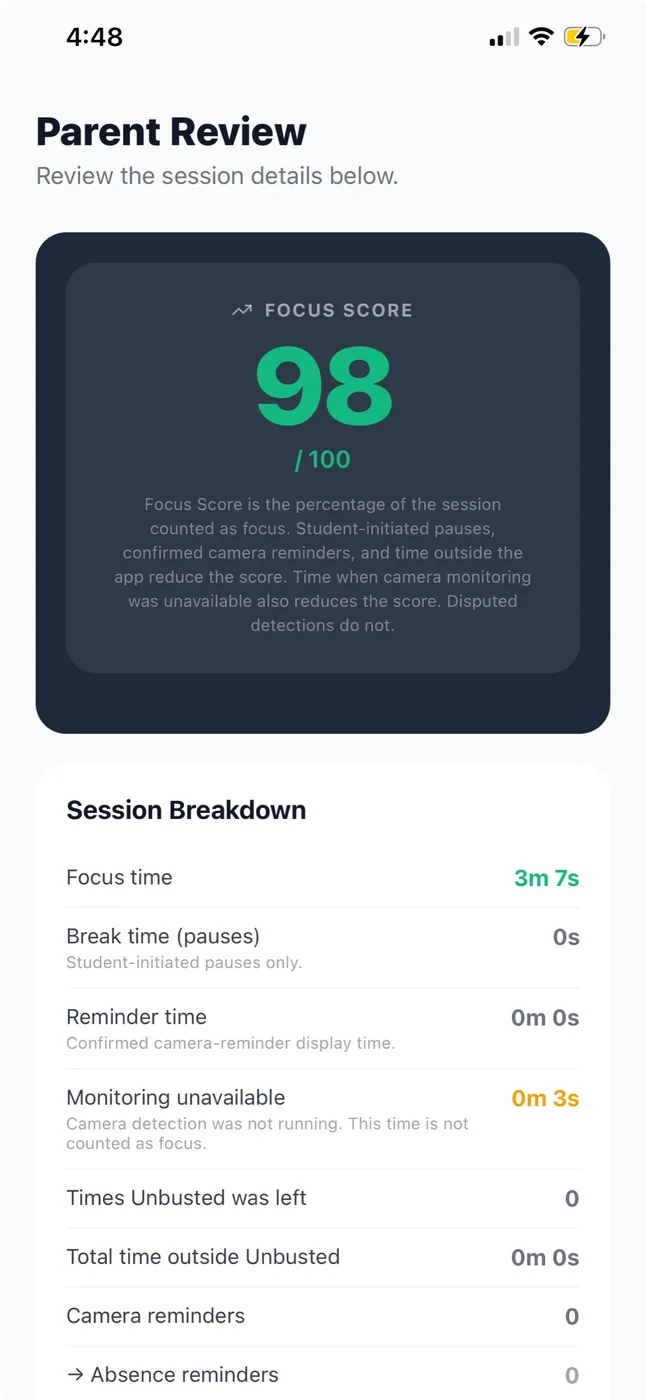
That approach won’t suit every teen or every homework session. It’s one option for families who want their teen to keep the phone nearby while practicing a more deliberate way to use it. Homework is the entry point. The bigger mission is helping young people reclaim some control over their attention.
Curious what it looks like when the phone becomes the focus tool? Meet Unbusted and see how it works.
The school rule is only one part of the story
School phone policies can create a clearer boundary during the day. AMLE’s paper asks the deeper question: are we also helping young people practice managing their attention, so they can use these devices as tools rather than being used by them?3
At home, you get to answer that question where it matters most — not by removing the phone, but by changing what it does.
The phone stays. The focus changes. And the choice belongs to them.
Scene illustrations on this page are AI-generated.
What if the phone causing the distraction could help solve it?
Meet Unbusted—the focus coach that helps students practice self-discipline using the phone they already own.
Download on the App Store